
Birds Nesting Under Solar Panels: What It Actually Costs You
Birds nesting under solar panels is one of those problems that sounds cosmetic until the bill arrives in four different forms: a system producing less than it should, droppings eating the roof, a fire risk packed against the wiring, and mites in the bedroom below. This guide walks through what actually happens under an Adelaide array once pigeons move in, and what it costs to stop it compared with leaving it.

- OutputShaded cells, hot panels
- WiringDry nest against DC connectors
- RoofAcidic droppings, blocked gutters
- HouseholdMites when the birds leave
- SleepCooing at first light, worse in spring
Why is the gap under a panel ideal for pigeons?
Because it is a cliff ledge with a roof on it. The space between a panel and the tiles is dry, shaded, warm from the glass above, closed on three sides and open on one, which is exactly the nesting shelf a feral pigeon evolved to use.
One pair becomes a colony. Droppings and calls advertise the site, and within a season every panel on the array can have a nest under it, with starlings and sparrows taking the smaller gaps the pigeons leave.
How much output do you lose to shading and droppings?
More than the size of the mess suggests, because of how a string works. Panels are wired in series, so a single cell shaded by a dropping drags down the output of the whole string it belongs to, not just its own panel. Nesting material packed underneath then blocks the airflow the panel relies on to shed heat, and a hot panel produces less again. The two losses stack quietly on the bill and nobody sees them from the ground.
Symes SA does not quote a percentage, because the loss depends on the array, the string layout and the nesting, and someone else's number is not yours. What can be said is that cleaned and proofed arrays commonly produce more afterwards than they did with birds in residence, and that the loss stops the day the mesh goes on.
What does nesting do to the wiring and cables?
It puts fuel beside a heat source. The DC cabling and connectors under an array run warm by design, and a nest is twigs, feathers, dry grass and droppings packed directly against them. A connector that develops a fault, or a cable chewed by the rats that follow the birds, has tinder on all sides. Clearing the nesting is not cosmetic; it removes the material a fault would ignite.
Birds and the rodents they attract also chew and foul cable insulation, and droppings corrode the metal parts of connectors over time.
How do acidic droppings damage the roof and gutters?
Pigeon droppings are acidic, and they land in the same places every day. On tiles they etch the surface and leave the white streaks that never fully wash off; on Colorbond they attack the coating and start the rust that spreads under the paint; on the panel glass they leave a film that shades the cells and can mark the surface. Nesting material then washes out of the array in rain, into the gutter, where it blocks the outlet and sends water over the fascia.
A manufacturer warranty problem sits behind this. Corrosive droppings that damage the panel surface can be argued to be an environmental cause outside the panel warranty.
How do bird mites move from the nest into the house?
Through the roof, once the birds are gone. Every active pigeon nest carries mites that feed on the chicks. While the nest is occupied they stay put. When it empties, whether the birds fledge, are chased off, or the array is proofed without a mite treatment, the mites are left without a host and set off after a warm body, down through the roof space, the light fittings and the cornice gaps into the nearest bedroom.
The pattern Symes SA sees repeatedly is a household that had pigeons under the panels, had them removed, and a week or two later has someone waking with bites and a crawling feeling at night, with nothing to show in the bed. That is why the mite treatment is offered with every proofing job where nesting was active, and why the bird mite treatment page starts with the roof rather than the bedroom.
Why does the noise get worse in spring?
Because spring is when the colony breeds. Pigeons nest through much of the year in Adelaide, but the numbers, the courting and the squabbling over the best panel all peak in spring, and the cooing starts at first light on the roof directly above the bedroom. Chicks add begging calls, and a nest that fledges is reoccupied within days.
Spring is also when a proofing job has to be planned around chicks. Edward will not seal birds in; where a nest has young the work is timed for after they fledge, so late winter is the time to deal with an array.
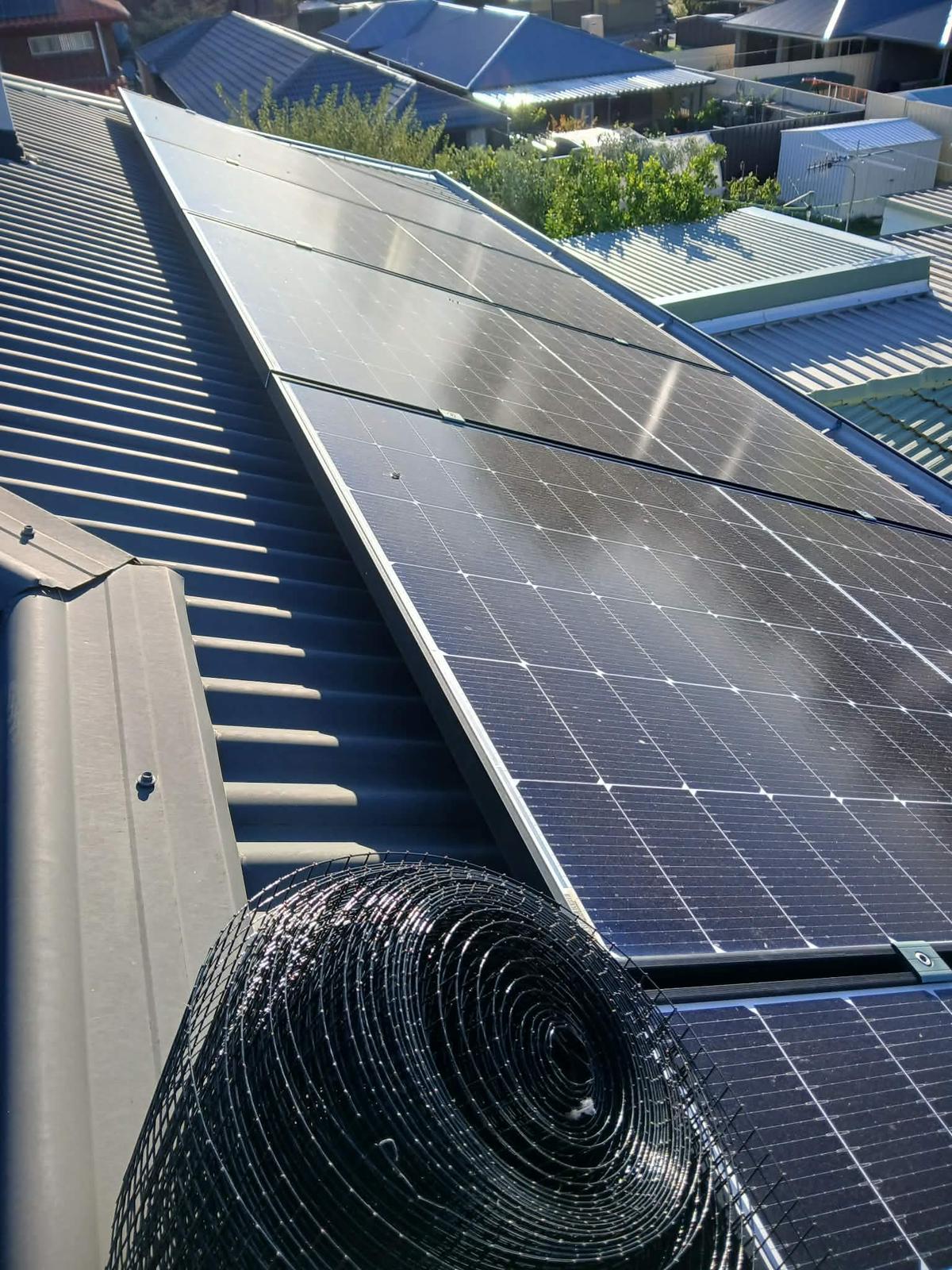 Install day, nests cleared first
What does it cost to fix versus what does it cost to ignore?
Fixing it is one quoted visit: nests cleared, mesh fitted around the array, optional mite spray and clean, with the mesh under a 25 year product warranty. Ignoring it is a running bill with no invoice: output lost every sunny day, roof coating eaten, gutters overflowing, a fire risk that grows each season, and a mite treatment you end up needing anyway when the birds move on by themselves.
Fix it once
- One visit, two to four hours, quoted first.
- Nests and droppings cleared, fire fuel gone.
- Mesh warranted for 25 years.
- Output recovers once the glass is clean.
Leave it
- Lower output on every string with a nest.
- Etched tiles, rusting Colorbond, blocked gutters.
- Dry nest packed against DC connectors.
- Mites in the bedroom when the colony moves.
How does proofing actually work?
By closing the gap rather than scaring the birds. A barrier of PVC-coated steel mesh is cut to the array's outline and fixed to the panel frames with nylon clips, so the space underneath is no longer reachable. Nothing is drilled, the panels and the roof are untouched, and the nests are cleared out before the mesh goes on so the fire risk and the mites go with them.
Deterrents, spikes, plastic owls and gel all leave the cavity open and the pigeons work around them within weeks. Material and fixing detail is under solar panel bird proofing, and birds roosting elsewhere on the building, on parapets, under verandahs or in the eaves, are handled as pigeon and bird control.
Birds nesting under solar panels: what owners ask first
How do I know if birds are under my panels?
Cooing at dawn from the roof, pigeons landing on and walking off the array, white streaks on the tiles or Colorbond directly below it, feathers and twigs in the gutter, and an output figure on the inverter that has drifted down.
Will it damage my solar system?
It can, in three ways. Droppings on the glass cut output across the whole string and can mark the panel surface, nesting material against the DC wiring is a fire risk and attracts rodents that chew cable, and the acidic mess corrodes connectors and the roof around the array. None of it is visible until the nests are cleared.
Can I just remove the nest myself?
You can clear what you can reach, but it does not solve anything: the gap is still open and the pair is back within days, and disturbing a nest sends the mites in it looking for you. The lasting fix is closing the gap with mesh after the nests are out, with the mite treatment where nesting was heavy.
Do bird spikes work on solar panels?
No. Spikes stop a bird landing on a ledge, but under a panel the problem is a cavity, and a row of spikes at its edge does not close it. Pigeons walk past them. Only a barrier that closes the space, fixed so it cannot be lifted, keeps the birds out for the life of the system.
Cooing above the bedroom? Close the gap before spring fills it.
Nests cleared, PVC-coated steel mesh clipped on, nothing drilled, 25 year product warranty. Quote from a photo of the array.