
General Pest Control in Adelaide
The general pest control Adelaide homes actually need is a four-zone treatment, not a can of spray along the skirting. Symes SA treats inside, outside, the wall cavities and the roof space in one visit, with licence-only products and a warranty written on the certified invoice.
- Treatment zones covered in one visit4
- Time on site for a standard home1 to 3 hours
- Covered without a separate quoteSpiders, ants, cockroaches, silverfish
- Products usedLicence-only, trade strength
- What you leave withCertified invoice and warranty
What does a general pest treatment cover?
A general treatment covers the crawling insects that live in and around an Adelaide house: spiders, ants, cockroaches, silverfish, carpet beetles, fabric pests, earwigs and millipedes. It does not cover rodents, termites, bed bugs, fleas or bees, because each needs its own method and is quoted as a targeted job.
A general job is built around a residual insecticide that stays active for months, applied in the four zones below, so any insect crossing a treated edge in the following weeks picks up a dose. Targeted jobs use different tools: bait stations and sealing for rats, a growth regulator for fleas, repeat visits for bed bugs.
Most calls start with one pest and end as a general treatment, because the spider on the wall and the ants on the bench come from the same untreated perimeter. If you are unsure which side of the line you are on, the service decision table matches symptom to job.
Included in a general treatment
One visit, four zones, one price- Black house, redback, white tail and huntsman spiders
- Black house, sugar and coastal brown ants
- American and Australian cockroaches
- Silverfish
- Carpet beetles and clothes moths
- Earwigs, millipedes and slaters
Quoted as a targeted job
Own method, own product, own follow-up- Rats and mice: bait, trap and seal
- German cockroaches: gel bait program
- Argentine ants: nest baiting
- Bed bugs, fleas and ticks
- Termites
- Bees, wasps, pigeons and bird mites
How are the four treatment zones done?
The four zones are the inside of the house, the outside perimeter, the wall cavities and the roof space. Each takes a different product form and a different tool, because a liquid that works on a skirting board is useless in a roof void, and a dust that works in the roof would be a mess on a bench.
Internal spray: what gets treated inside the house?
The internal spray is a low-pressure band of residual insecticide along the junction of floor and wall, behind and under appliances, inside kitchen kick boards, and around door and window frames. It is not a fog and it does not go on surfaces you touch or prepare food on.
The product class is a synthetic pyrethroid residual, which binds to porous surfaces and keeps working for months. It goes on as a band about a hand wide, enough for a walking insect to cross. Wet areas and the space behind the fridge get the most attention because that is where cockroaches and silverfish harbour.
- Tool
- Compression sprayer, fan nozzle, low pressure to avoid drift
- Product class
- Synthetic pyrethroid residual, trade concentrate mixed at label rate
- Where it goes
- Skirting junction, behind appliances, kick boards, wardrobe bases, door frames
- Where it does not
- Benches, bedding, toys, food surfaces, fish tanks and bird cages, which are covered or moved
- Back in the room
- Once the band is dry, which Edward confirms before he leaves
- Tool
- Backpack sprayer at higher volume, adjusted for wind and surface
- Product class
- Exterior-rated synthetic pyrethroid residual, longer-lasting formulation on brick and render
- Where it goes
- Slab edge, weep holes, thresholds, eaves, vent surrounds, pergola posts, fence line, paving joints
- Webs
- Brushed down first, otherwise the spider sits above the treated surface and never contacts it
- Weather
- Not applied in rain or onto wet surfaces; rescheduled if the forecast will wash it off
External spray: where does the perimeter barrier go?
The external spray is the barrier that stops insects walking in from the garden. It runs along the slab edge and every point where outside meets inside: weep holes, thresholds, window surrounds, vents, eaves and the gutter line, then out to pergolas, retaining walls and the fence.
This is the zone cheap jobs skimp on, because it is slow and nobody sees it. Eaves get product where black house spiders build, and paving joints are covered because that is where ant trails begin.
Wall cavity treatment: how does product get inside the walls?
Wall cavity treatment puts product inside the void between the plaster and the outer wall, where ants and cockroaches travel and a surface spray cannot reach. It goes in through gaps that already exist: power point and switch plates, pipe penetrations under sinks, and the gap behind the kick board.
Nothing is drilled. The product form is a dust rather than a liquid, because dust drifts through a cavity and coats the framing, whereas a liquid runs to the bottom plate and stops. The cavities behind the kitchen and bathroom get priority because those warm, damp voids are the ones insects prefer.
- Tool
- Hand bellows duster or electric puffer with a narrow nozzle
- Product class
- Insecticidal dust, pyrethroid or inorganic desiccant depending on the cavity and the pest
- Entry points
- Behind switch plates with the power off, pipe penetrations, kick board gaps, wall vents
- Amount
- A measured puff per point, not a fill, so nothing leaks back into the room
- Why it matters
- Cavities are the highway between roof and skirting, where an untreated colony sits out a surface spray
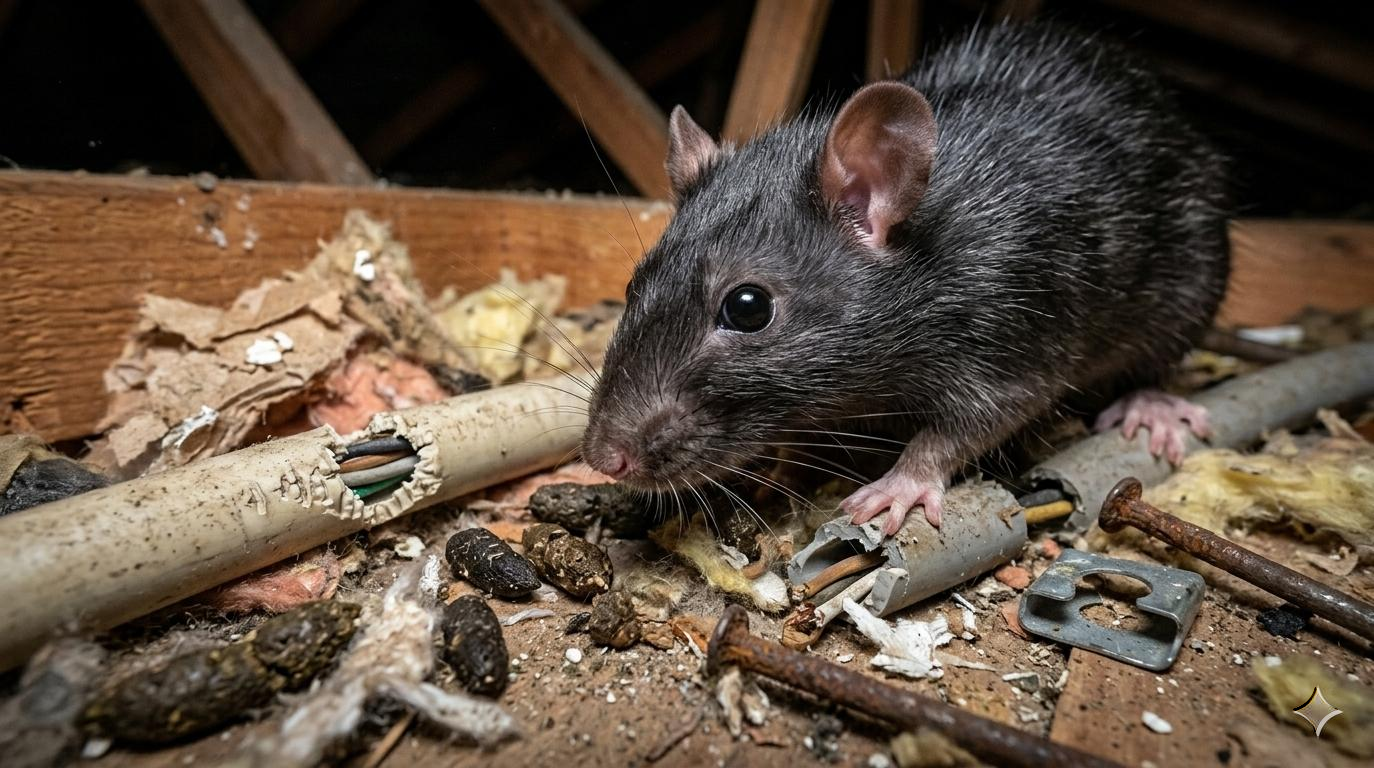 Roof void, the fourth zone
Roof dusting: why is the roof void the zone that matters most?
Roof dusting is an insecticidal dust blown through the roof space so it settles on the timbers, the top of the ceiling and the insulation. It is the most effective step in the whole treatment for spiders, and the one retail products cannot copy, because the equipment and the product both need a licence.
The roof void is where spiders breed, where ant colonies nest in the warmth above the ceiling, and where cockroaches move between rooms unseen. A powered duster is fed through the manhole and worked across the whole void so the dust reaches the eaves line, not just the hatch. It is dry, odourless and keeps working for months because nothing washes it away. Rodent evidence up there, like the droppings in the photo, adds a rat and mouse control job to the visit, and the sealing that follows is the same work described under roof possum proofing.
Which products do we use, and why are they trade-only?
Symes SA uses four product classes: synthetic pyrethroid residual concentrates for the sprays, insecticidal dusts for cavities and roof voids, gel baits for cockroaches and ants, and insect growth regulators for fleas and moths. All four are sold only to licensed operators, at strengths retail versions cannot match.
The difference is less the chemistry than the strength, the formulation and the person applying it. A hardware store aerosol is a diluted, ready-to-use version made safe for someone with no training. A trade concentrate is mixed at label rate, applied with the right equipment to the right surface, and formulated to last for months. That is why one licensed general pest control Adelaide treatment usually replaces a cupboard of retail cans, and why the invoice carries a warranty.
| Product class | Used for | Applied where | What the retail version lacks |
|---|---|---|---|
| Synthetic pyrethroid residual concentrate | Spiders, ants, cockroaches, silverfish, general crawling insects | Internal band spray and external perimeter | Strength and residual life; retail sprays break down within days |
| Insecticidal dust | Spiders and cockroaches in voids, ant colonies above the ceiling | Wall cavities and the roof space | Not sold at trade grade, and the powered duster is not available to the public |
| Gel bait | German cockroaches, sugar ants, coastal brown ants | Harbourages in kitchens, along ant trails to the nest | Lower active loadings and the wrong food matrix, so the colony ignores them |
| Insect growth regulator | Fleas, clothes moths, carpet beetles | Carpets, pet areas, wardrobes, yard | Rarely sold retail; without it the eggs hatch after the adults die |
Which product goes where is decided from what the inspection finds. Re-entry times are explained before treatment starts, and pet-safe and low-toxicity options are used wherever a household needs them.
How often should an Adelaide home be treated?
Once a year is the right interval for most Adelaide homes, ideally in spring before the summer insect season. Homes backing onto scrub, rentals between tenants, and any kitchen that has had German cockroaches do better on a six-monthly cycle. Food businesses follow a program set by their audit requirements.
The residual products keep working for months, but Adelaide's seasons refill the garden with new insects every year. A spring treatment catches the spider and ant build-up before it peaks; an autumn one catches rodents and cockroaches heading for a warm roof.
Rentals are the exception, where timing is set by the lease. An end of lease pest control visit is done after the tenant moves out, invoiced so the property manager can see what was treated.
- SpringAnts start trailing, spiders spread to the eaves. Best time for the annual treatment.
- SummerCockroach and fly pressure peaks. Bees swarm and European wasps nest in cavities.
- AutumnRats and mice move into roofs and subfloors as nights cool.
- WinterIndoor pests gather near warmth: silverfish, carpet beetles, roof-space activity.
Which pests do we treat, and where does each one go?
Every pest Symes SA treats has its own page covering the Adelaide species, the method and what to expect afterwards. The label on each card shows whether it is covered by the general treatment on this page or quoted as a targeted job.
Own pages: termite inspection, bee removal, wasp nest removal, pigeon control, bird mite treatment.
different situations
The four-zone method is the base for residential pest control in family homes, commercial pest control in shops and food premises, and same day pest control when it cannot wait. Pricing is on the pest control cost page, and the guide to choosing a pest controller in Adelaide lists what to ask any operator.
General pest control Adelaide: common questions
What is the difference between a general treatment and a targeted one?
A general treatment is one residual product applied across all four zones for the crawling insects around every house. A targeted treatment is built for one pest the general method does not reach: rodents need bait, traps and sealing, fleas a growth regulator, bed bugs repeat visits. Targeted jobs are quoted separately and often done in the same visit.
How long before I see results?
Spiders, ants and cockroaches that contact a treated surface die within hours, so activity drops sharply in the first day or two. Insects hiding in the roof or garden keep meeting treated edges for weeks, so a few slow or dead insects in the first fortnight is the treatment working.
Will one treatment be enough?
In most cases, yes. One professional treatment across all four zones is sufficient for the insects a general job covers. Severe infestations and certain species, German cockroaches and bed bugs in particular, need a follow-up, and Edward says so in the quote rather than booking a return you did not need. If the pest returns inside the warranty period on your invoice, he comes back to assess and retreat.
What do I need to do before you arrive?
Clear the floor edges where you can, so skirting boards, the space behind the fridge and under the sink are reachable. Put away pet bowls, cover fish tanks and move bird cages into an untreated room. Pets and children stay out of treated rooms until the spray is dry, which Edward confirms before leaving. Nothing else needs moving.
Four zones, one visit, one licensed technician.
Book a general pest treatment for your Adelaide home or business. Edward inspects first, quotes before starting, and the invoice carries the warranty.