
Pigeon & Bird Control in Adelaide
Pigeon control Adelaide roofs need is exclusion: closing the ledge, the gap or the space under the panels so the birds cannot physically land or nest there. Spikes, gels, owls and reflective tape move a pigeon along for a week. Symes SA fits PVC coated steel mesh and netting that closes the roost for good, clears the droppings and nests, and treats the mites the birds leave behind.
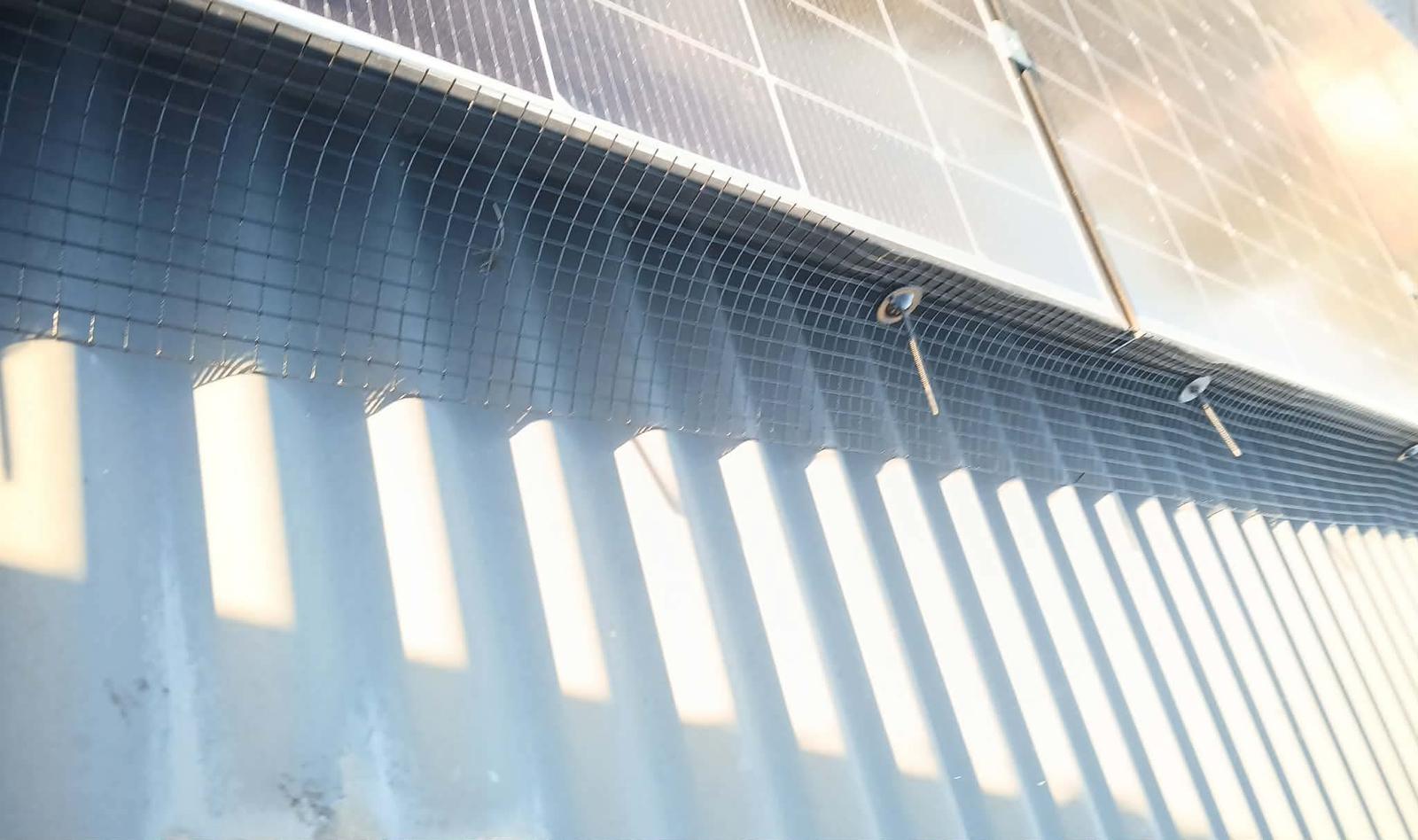 Roost closed under the panels
Why do pigeons keep returning to the same roost?
Because a pigeon is loyal to a site, not a food source. Once a pair has roosted or nested on a ledge, under a solar array or in an eave, it returns every night for the rest of its life, and its young come back to breed where they hatched.
Feral pigeons are cliff birds, and an Adelaide roofline is a cliff with the weather taken out: a ledge under a solar panel, a parapet on a shop, the top of a rainwater tank, an open eave. They pick the most sheltered spot on the block and the flock grows there until the spot is physically closed.
A deterrent asks the bird to leave a site it is bonded to; exclusion removes the site. The most common roost Symes SA closes is the gap under solar panels, described under solar panel bird proofing.
- Site loyaltyA roost or nest site is used for life and inherited by the young.
- Shelter is the drawUnder panels, on parapets, in eaves: anywhere out of wind and rain.
- Closing the site ends itMesh and netting remove the ledge; the flock finds another block.
Why does exclusion beat deterrents every time?
Deterrents rely on the bird being frightened or uncomfortable, and pigeons stop being either within days. Spikes get nested on top of, gels dry out and collect dust, plastic owls become perches, and reflective tape is ignored once the flock has seen it in the rain. Exclusion does not rely on the bird's behaviour at all: mesh or netting makes the site impossible to enter.
| Method | What it does | Result on a bonded roost | Where it has a place |
|---|---|---|---|
| PVC coated steel mesh | Physically closes the gap under panels, tanks and eaves | Permanent; the site no longer exists | Solar arrays, gaps at eaves, behind tanks and units |
| Bird netting | Encloses a larger space such as a verandah, a courtyard or a loading dock | Permanent while the net is intact | Open structures pigeons fly into |
| Spikes | Make a narrow ledge uncomfortable to land on | Nested on top of; debris fills them | Narrow sills where mesh cannot fit |
| Gels and repellents | Sticky or scented surface | Dries and dusts over within months | Rarely; short-term at best |
| Owls, tape, sound devices | Frighten the bird | Ignored within days | Not on a roost the birds already use |
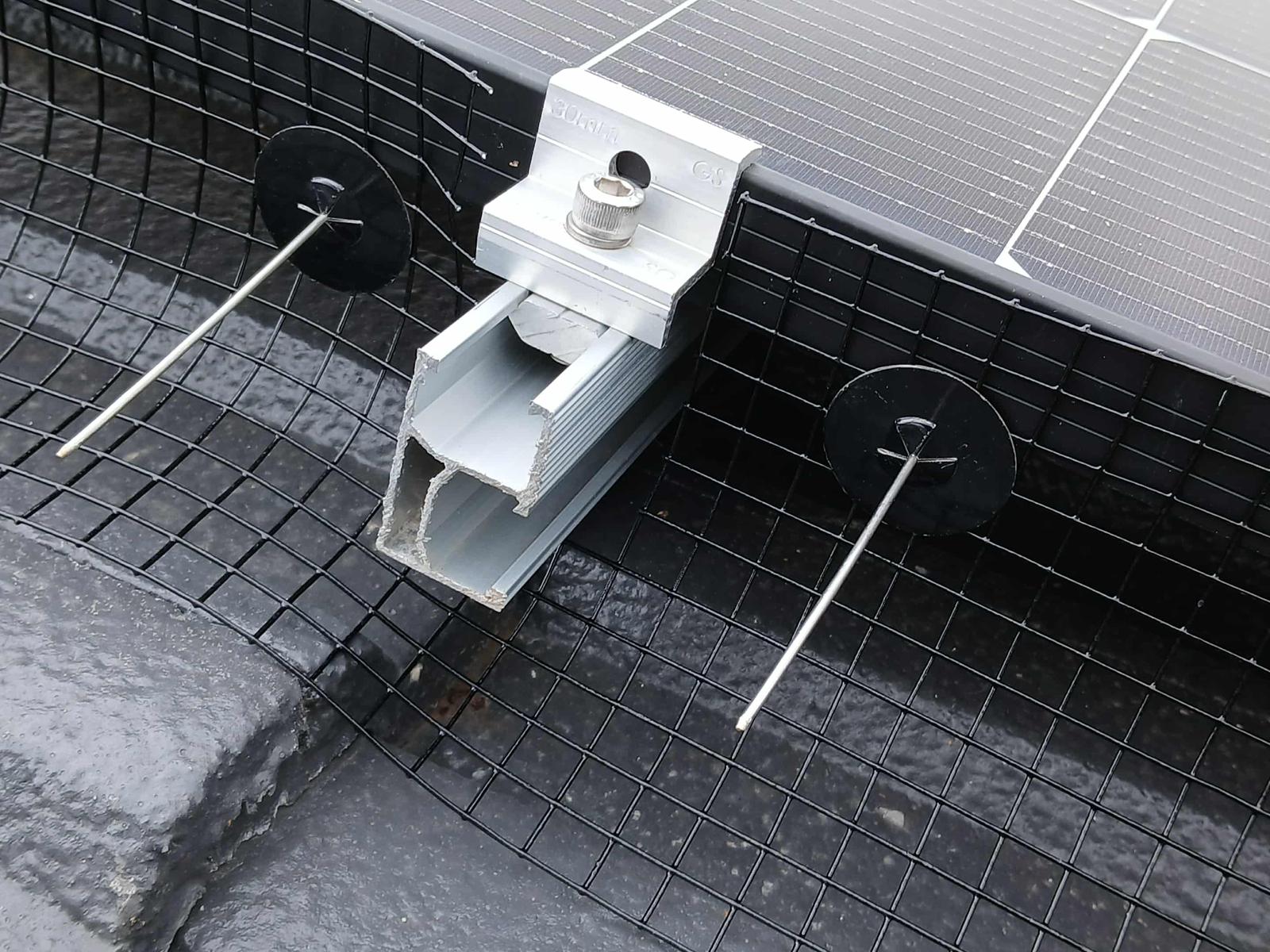 Mesh clipped to the panel frame
What mesh, netting and spike work do we do?
Steel wire mesh in a PVC coating is the main material: strong enough that a pigeon cannot push through it, coated so it does not rust, and fixed with clips rather than screws so the panel, tile or sheet it is protecting is not drilled. Netting is used where a whole space needs closing, and spikes only on the narrow sills where nothing else fits.
Around a solar array the mesh follows the panel perimeter and is clipped to the frame with fail-safe nylon clips and C-clips, with a 25 year product warranty on the mesh. Behind a tank, an air conditioning unit or at an open eave it is cut to the gap and fixed without penetrating the roof. Under a verandah or shopfront awning a tensioned net closes the whole opening. Material and fixing detail is on the bird proofing specification page.
Why are solar panels the most common roost we see?
Because the gap between panel and roof is a perfect ledge: 100 to 150 mm of dry, shaded, warm space, closed on three sides. On a street with a dozen arrays the pigeons pick one, nest under it, and within a season every panel on that roof has birds under it and droppings running down the tiles below.
- Under solar panelsThe most common roost by far. Nesting material, mites and droppings under the array, and output loss from soiled glass.
- Behind rainwater tanksThe gap between the tank and the wall is sheltered and rarely looked at.
- Open eaves and gable endsOlder homes with no eave lining give pigeons a dry shelf on the top plate.
- Parapets and awningsShops, units and warehouses with flat ledges and the space under an awning.
- Air conditioning unitsRoof units and their ducting make a shaded, warm ledge.
What nesting under panels does to a system over time, from fire risk to warranty problems, is set out in the guide to birds nesting under solar panels.
Droppings: what is the health and corrosion problem?
Pigeon droppings are acidic enough to etch panel glass, paint and Colorbond over time, and dry droppings carry spores and bacteria that go airborne when disturbed. A heavy build-up is cleaned wet, not swept, bagged and the surface disinfected before any mesh goes on.
Wet it down first
Dry droppings are never swept or blown. The build-up is dampened so spores and dust are not raised.
Scrape and bag
Nests, feathers and droppings are scraped, bagged and removed from the roof, not washed into the gutter.
Disinfect the surface
The ledge, the roof under the panels or the balcony floor is treated so the residue and the smell do not draw the flock back.
Then exclude
Mesh or netting goes on a clean surface. Proofing over old droppings seals the problem in.
What about bird mites after the birds are gone?
Bird mites live in the nest and feed on the birds. When the nest is removed or the birds are excluded, the mites lose their host and go looking for another one, down through the roof space and into the rooms below. The bites usually start a few days after a proofing job, which is why the mite treatment is done with the proofing, not after the complaint.
The treatment is a spray of the roof space and the cavities under the old roost and, where the mites are already inside, the rooms below. Done with the exclusion it is a small addition; done a fortnight later, after the household has been bitten, it involves bedding and furniture too. The full picture, including how to tell mite bites from fleas and bed bugs, is under bird mite treatment.
- Mites live in the nestThousands per nest, feeding on the chicks and adults.
- They move when the birds goDown through the roof space and into the rooms below within days.
- Treat with the proofingRoof space and cavities sprayed on the same visit as the mesh.
- Bites without the treatmentAnkles and arms at night, a week after the birds left.
What about starlings, sparrows and mynas?
Starlings, sparrows and Indian mynas use smaller gaps: under lifted ridge tiles, behind a gutter, in a roof vent or a hole in the eave lining. They nest in the roof void itself and bring the same mites and fire risk from dry nesting material. Exclusion is the same principle with a finer mesh over a smaller hole.
The job is finding every gap the birds use, watching the roof at dawn and dusk, then closing each one with mesh or flashing after the nests come out. Starlings try every other gap along the eave once the first is closed, so the whole roofline is checked rather than the one hole you noticed.
What does bird proofing cost?
Bird proofing is quoted after a roof inspection, on the area to be closed, the material it needs, the nesting and droppings to clear first, and whether a mite treatment is added. A solar array is priced by panel count; a tank, eave or parapet by metres of mesh or netting; access and pitch move the figure on any of them.
- 1Area to closePanels, metres of eave or parapet, or the size of a netted opening.
- 2Cleanup firstHeavy droppings and nesting add clearing and disinfecting time.
- 3Roof accessTwo storeys, steep tile and parapets take longer and need more care.
- 4Mite treatmentAdded to the same visit where the roost was active.
You get the figure in writing before the work, and the invoice carries it along with the 25 year product warranty on the mesh.
Pigeon control Adelaide: what people ask before proofing
Do bird spikes actually work?
On a narrow sill a pigeon has not bonded to, sometimes. On a roost the birds already use, no: they nest on top of the spikes, debris fills the gaps and the spikes become part of the shelter. Spikes have a place on ledges too narrow for mesh, but they are not a fix for pigeons under solar panels, behind a tank or in an eave. Closing the site with mesh is.
Is it legal to remove pigeons?
Feral pigeons, starlings, sparrows and Indian mynas are introduced species and are not protected in South Australia, so removing their nests and excluding them from a roof is legal. Native birds are protected, and a native nest with eggs or chicks is worked around until they have fledged. Exclusion is done so that no bird is sealed inside, which is why the roof is checked before the last gap is closed.
What about the droppings already there?
They are removed as part of the job. The build-up is wet down so nothing airborne is raised, scraped and bagged off the roof, and the surface is disinfected before the mesh or net goes on. Droppings left under a proofed array keep corroding the roof and keep the mites alive, so cleanup is standard rather than optional.
Will they just move to the neighbour's roof?
Often, yes. Exclusion removes the site from your roof; it does not remove the pigeons from the street. A flock that has lost its roost looks for the next sheltered ledge, and an unproofed solar array two doors down is the obvious candidate. That is the honest answer, and it is why proofing before the birds arrive is cheaper than proofing after a season of nesting.
Cooing at dawn and whitewash down the tiles?
Roost cleared, disinfected and closed with PVC coated steel mesh. Mites treated on the same visit. No spikes, no owls, no drilling.